
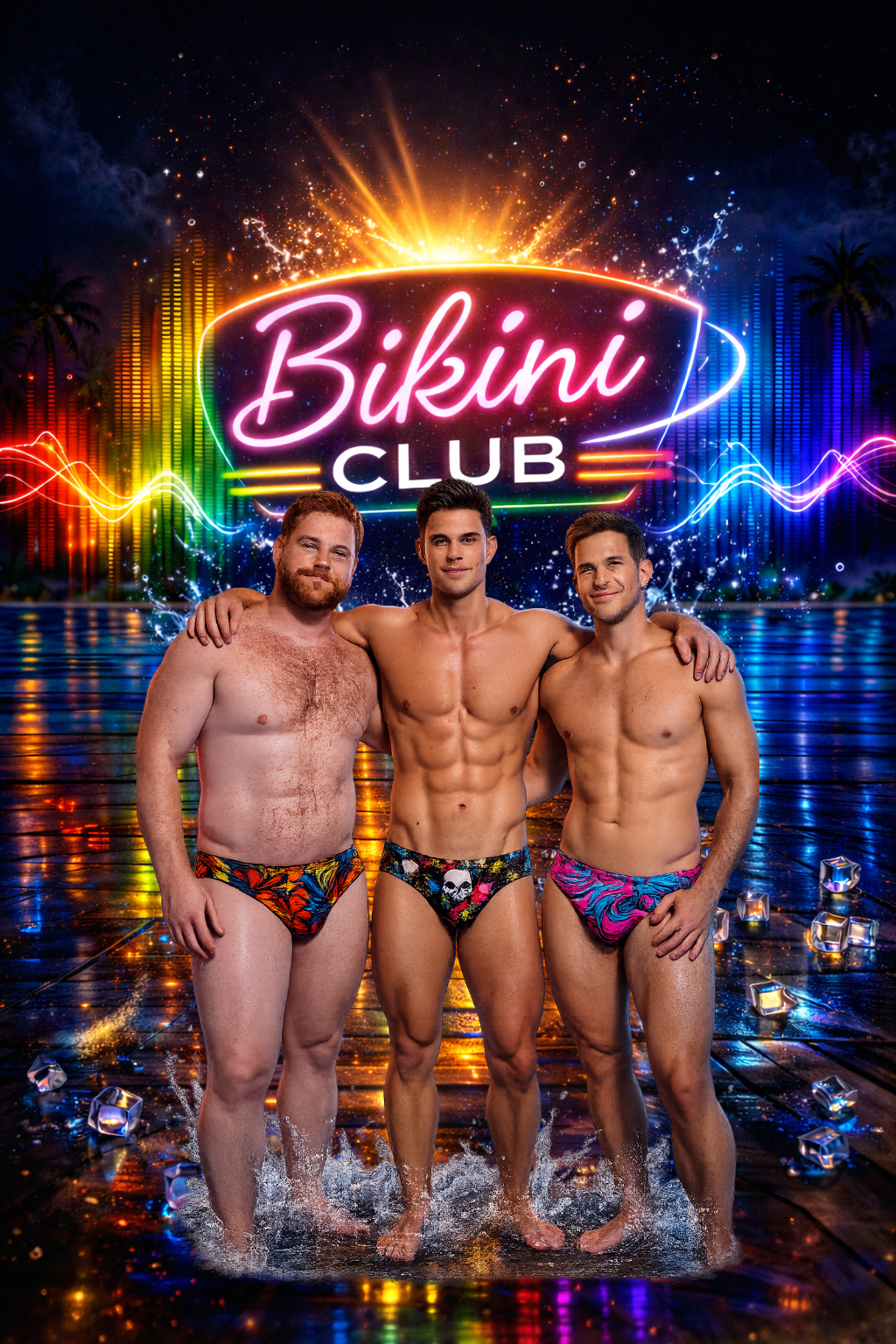
Bikini Club wasn’t planned. There was no strategy, no big reveal, and no detailed roadmap. It began as a throwaway line in a Sora video, where I was doing an over-the-top bro-drag fantasy—rooftop scenes, wild competition briefs, exaggerated confidence. In the midst of it, I said, “Bikini Club.” It stuck—a punchline, a phrase that captured the video’s playful energy.
But something about it stuck with me, and that changed everything.
After the video, I couldn’t stop thinking about it. I made more videos—fake Bikini Club events, Vegas day clubs, beach weekends, and guys in bright speedos walking confidently. At first, it felt like typical fantasy storytelling. But the more I worked on it, the more I wanted to experience it in real life.
Reflecting on this, I realized something that surprised me.
It wasn’t about the Speedos. It wasn’t even about the visuals. It was about the feeling underneath it all.
When I reflected on what I was creating, the core theme became clear: confidence. Men encouraging one another instead of competing, the celebration of diverse bodies, and joy without apology. At its heart, Bikini Club expresses what I wish had existed when I was younger—a supportive, visible space.
In the late ’80s and through the ’90s, wearing a swim brief wasn’t just about style for me. It made me feel vulnerable and exposed, both physically and socially. I was always aware of who might be watching and what they might be thinking. Was I okay? Was I too much or not enough? Growing up and coming out, even when being visible could still be risky, changed how I moved through the world. I learned to be cautious, to scan rooms, and to shrink myself when needed.
I used to go lie out in Piedmont Park during the week because it was quieter. Fewer people meant fewer stares, fewer variables. I wasn’t the loudest guy. I wasn’t the most confident. But when I was in a speedo in the sun, I felt closer to myself than almost anywhere else. It was one of the few places where I felt aligned in my body. That feeling mattered more than I probably understood at the time.
Confidence wasn’t something I was born with. I built it through experience and community—by finding people who made spaces feel safer and by exploring underwear and swimwear as expressions of identity. Over time, this led to UNB, the podcast, and conversations about masculinity, body image, vulnerability, and expression. At heart, my goal has always been to help men feel comfortable in their own skin.
Bringing this all together, when I started imagining Bikini Club as something real, I realized it was an extension of that same mission.
Bikini Club might look superficial, but its true purpose is empowering men to embrace themselves, normalize confidence, celebrate all body types, and foster meaningful camaraderie far beyond appearances.
What surprised me most was that the fantasy I was creating wasn’t about escaping reality; it was about aspiration. I wasn’t picturing wild parties just for show. I was imagining brotherhood without toxicity, energy without ego, and a space where men support each other rather than compare. I wanted a family built on confidence, not hierarchy.
That was the turning point: it stopped being a joke.
From that moment on, it felt like a calling.
Years of building community through UNB—writing, podcasting, sharing stories—have shown me how powerful it is when men open up. When someone says, “I thought I was the only one,” it’s transformative. Bikini Club feels like the next step—giving these conversations a real, shared space.
There will be fun events, but the heart of Bikini Club is fostering spaces where men feel seen, accepted, and supported—promoting normalcy in visibility and breaking free from limiting standards.
It’s what would happen if swim briefs were mainstream.
After I started developing Bikini Club, it felt like swim briefs were what guys wore, and if you wore something different, “what was wrong with you?” It’s Bikni Club Bro! It’s a fun alternate reality where everything we love is mainstream, and the board shorts and such are shunned. It’s like, “Are you a real man if you don’t rock the brief?” The more I develop it, the more of this concept is taking over, and we need to make it happen.
It’s about reclaiming space.
For decades, men were told to cover up, to tone it down, and to blend in. Queer men especially learned to be careful about being seen. Bigger men were told to shrink themselves, and sensitive men were told to act tougher. Bikini Club quietly stands against all of that—not with aggression or arrogance, but with confidence.
We’re here. We’re visible. We’re not apologizing.
Looking back, it’s striking that none of this began with a strategy session. Instead, it grew from a spontaneous line in a video and from recognizing how much I wanted that joy to exist in real life.
Bikini Club was meant as a fantasy. But it reflected what I cared about: confidence, family, self-expression, visibility, and freedom in your own body.
Sometimes, the things that matter most don’t come with a formal introduction. They might start as a joke, a vibe, or a creative experiment—and then they just won’t let you go.
Now, Bikini Club isn’t just an idea anymore. It’s a community I want to build.
I want to build a supportive family—a community for everyone who connects with Bikini Club’s purpose.
You’re already part of it.
